
Mercedes-Benz Remapping – Models, Engines and Typical Gains
Mercedes-Benz engineers their powertrains with generous mechanical safety margins, making both their diesel and petrol lineups prime candidates for software tuning. Across everything from high-mileage OM651 and OM654 diesels to the punchy M260, M139 engines, and biturbo AMG petrols, conservative factory maps leave substantial reserves untouched.
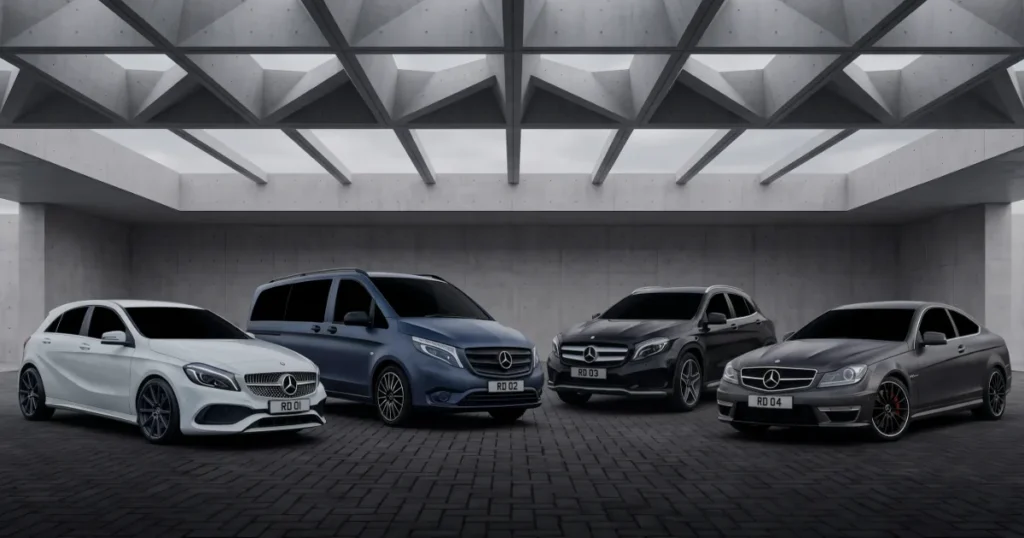
Drivers remap Mercedes-Benz vehicles to sharpen lethargic pedal response, iron out turbo lag, and widen mid-range acceleration. On executive diesels like the C220d and E220d, a Stage 1 calibration safely adds 35 to 45 bhp and 70 to 90 Nm of torque. That completely transforms effortless overtaking on motorways and A-roads while often returning 5 to 10% better fuel economy on long runs.
Performance models such as the A35 and A45 AMG pick up 45 to 60+ bhp from software alone, holding peak torque much deeper into the rev band without upsetting daily refinement.
A-Class
W176 (2012-2018) and W177 (2018+).
C-Class
W204 Saloon / S204 Estate / C204 Coupe (2007-2014), W205 etc.
E-Class
W212 Saloon / S212 Estate, W213, etc.
CLA
C117 Coupe / X117 Shooting Brake (2013-2019) and C118 Coupe / X118 Shooting Brake (2019+).
And many more Mercedes-Benz models.
More curated model and engine links will be added here in coming weeks and months! In the meantime, checkout the full vehicle search to quickly find typical ECU remapping gains.
Key points in chats about Mercedes-Benz remapping:
- 7G-Tronic and 9G-Tronic Transmission Limits:
Automatic Mercedes boxes use TCU torque limiters and conservative line pressures. Aligning the engine map with transmission software prevents short-shifting and lets the gearbox handle extra low-down torque without pulling timing. - Warranty and Flash Counters:
Mercedes Star/Xentry dealer diagnostics check software checksums, flash counters, and calibration verification numbers (CVN). An aftermarket ECU remap will be spotted during routine dealer servicing and will void engine-related powertrain warranty claims. - Emissions and Sensor Calibration:
Modern Mercedes diesels use sensitive SCR/AdBlue and DPF sensor arrays alongside complex torque monitoring. Clean calibrations are essential to avoid triggering limp modes or throwing persistent NOx sensor faults under sustained motorway load.